


Romans, Brittenburg and Willibrord
In Roman times the Rhine formed the northern border of the Roman Empire here, and the river mouth at Katwijk was a strategic spot.
- The Limes: the Lower Germanic Limes, the frontier of the empire, ran along the Rhine; in Katwijk its course is marked with paving stones in the street.
- The Brittenburg: the Romans built a fort at the mouth of the river, whose remains were visible on the beach between Katwijk and Noordwijk after storms in the 15th, 16th and 17th centuries; it was eventually swallowed by the sea.
- Caligula (40): according to tradition, Emperor Caligula had a lighthouse built on this coast in the year 40 and ordered his soldiers to collect shells, though this story is also linked to other coastal places.
- Roman finds: excavations in Katwijk have uncovered human remains, pots, bronze objects and glass from the second century AD.
- Willibrord (690): in 690 the missionary Willibrord landed with eleven companions at the mouth of the Rhine, from where he brought Christianity to the Frisians.
The two Catwijcks: fishermen, lords and the Vuurbaak
In the Middle Ages Katwijk aan den Rijn and Katwijk aan Zee grew into a farming village and a fishing village under one lord.
- Catwijck (1224): in 1224 a charter of Count Floris IV first mentions Apud Rhenum Catwijck; the name may come from the Germanic tribe of the Chatti or from the old word kat for a fishing boat.
- The lords of Wassenaer: the manors of both Catwijcks and 't Zandt were largely owned by the house of Wassenaer from 1340 to 1795, with a period under the Van Ligne and Van Lyere families.
- Fish market by the sea (1388): in 1388 the fish market of Katwijk aan den Rijn moved to Katwijk aan Zee, which grew into a true fishing village with narrow lanes sheltered from the wind.
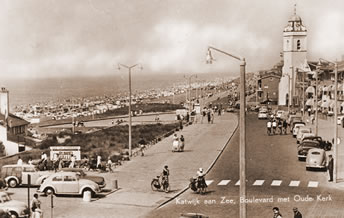
- The White Church (around 1460): when Katwijk aan Zee became a parish of its own around 1460, the Andreaskerk was built, now the White Church; after the sea swallowed many surrounding houses in the 17th century, the church ended up on the promenade.
- The Mallegat (1572): in 1572 a canal was dug from Katwijk aan den Rijn to the sea, but it silted up and ended as the Mallegat; only in the 19th century did the Rhine water find its way to the sea again through the Uitwateringskanaal.


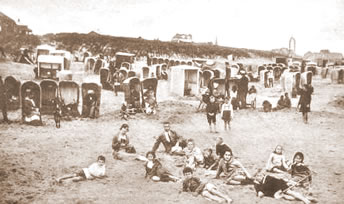
Bathers and the herring fleet
In the 19th century new life came to Katwijk, thanks to the healthy sea air and free herring fishing.
- The Groot Badhotel (1845): twenty investors built the Groot Badhotel in 1845, where the municipal doctor H. Polijn Büchner promoted sea bathing; guests came by stagecoach and later by omnibus from the station in Leiden.
- Rise and fall: the hotel was extended and modernised in 1919 and flourished until the stock market crash of 1929, after which it was demolished.
- Healthy sea air: in 1908 the Zeehospitium, a sanatorium for Rotterdam children with tuberculosis, came to Katwijk, followed in 1922 by the Leidsche buitenschool, an open air school for pale city children.
- Herring on the North Sea (1857): the Fisheries Act of 1857 freed herring fishing, after which Katwijk fishermen sailed further out onto the North Sea; as Katwijk has no harbour, their ships were based in IJmuiden from then on.
- The largest fleet: at the end of the 1960s Katwijk had the largest fishing fleet in the Netherlands with 180 ships, and the shipping company Parlevliet & Van der Plas grew into the country's largest fish processor.
The Atlantic Wall and Katwijk today
The Second World War changed the face of Katwijk aan Zee, after which the village grew together with its neighbours into one municipality.
- Demolished for the Atlantic Wall: during the war the Germans tore down a strip of houses some 200 metres wide along the coast to make way for the Atlantic Wall.
- A new promenade: only after the war did the promenade get its present appearance, with the White Church and the Vuurbaak as old landmarks.
- One municipality: at the end of the 1980s Katwijk aan Zee, Katwijk aan den Rijn and Katwijk-Noord grew together, and since 1 January 2006 Rijnsburg and Valkenburg have also been part of the municipality of Katwijk.
- A character of its own: church, family businesses and football long shaped a close community in the old village, which still has an atmosphere of its own.


